
What International Psychologists Need to Know
At Psych‑Recruitment, we welcome enquiries from psychologists worldwide who are interested in working in New Zealand. However, not all qualifications, training, or countries' regulatory systems align with our recruitment criteria. To be transparent, we outline the qualifications and training we focus on and explain why some countries are not listed on our website registration form.
Qualification, Training, and Regulation Equivalency
To work in New Zealand, all psychologists must be registered under the country’s statutory regulation system. If your background meets our requirements, we will first focus on whether your qualifications and training make you eligible for registration as a psychologist.
Voluntary vs Statutory Registration
If you trained or practiced in a country where psychologist registration is voluntary or not required, transitioning to New Zealand’s statutory system may require a significant shift in perspective. In voluntary systems, the title “psychologist” is usually not legally protected, and criteria focus mainly on academic degrees. In New Zealand, the title is legally protected and requires registration with the New Zealand Psychologists Board. Statutory regulators assess not just qualifications, but also public safety, legal scope of practice, and ongoing competence.
Scope of Practice
Not only is "psychologist" a protected title in New Zealand, practice is also regulated by specific scopes. Unlike voluntary systems, where anyone can use the title, or statutory systems that protect only the title ‘psychologist’, the NZ Psychologists Board (NZPB) registers psychologists within distinct scopes such as Clinical, Educational, Counselling, Neuropsychologist, General, or Intern. Each scope has its own qualification requirements. Qualifications matter twice: first, for recognition as a psychologist, and second, to determine your eligible scope. Registration as a Clinical Psychologist generally requires a doctorate or recognised post-master's clinical training; other scopes may accept a master's plus supervised internship. The scope you are registered in—not just the fact of registration—defines which roles you can apply for. For recruiters, scope is a significant filter: most vacancies specify a preferred scope, so your registration scope, not just experience, determines your eligibility.
Who Do We Recruit?
We only recruit fully qualified psychologists from specific scopes of practice, which include:
Clinical Psychologist
Forensic Psychologist (General Scope)
Educational Psychologist
Health Psychologist (General Scope)
Counselling Psychologist
Neuropsychologist
We require postgraduate qualification (post-master's) in clinical, forensic, educational, health, or neuropsychology. All our roles are applied positions focused on casework. We do not offer academic or research opportunities. If your practice scope does not match these requirements, we are unable to assist.
Understanding Equivalence Standards
When the New Zealand Psychologists Board evaluates overseas-trained psychologists, it looks for evidence that your qualifications, training, and regulation are equivalent to New Zealand’s standards. Equivalence means having similar depth, structure, and professional safeguards—not identical training. Key factors include:
Length, level and content of academic training.
Structure, number of hours and quality of supervised practice.
Accreditation and quality assurance of university programmes.
Existence of an acceptable psychologist regulator that enforces practice standards in your country.
History of registration or licence.
These factors help determine if your pathway aligns with New Zealand’s legal standards. There must be a minimum level of equivalency. Countries with similar systems are more likely to meet equivalence, while those still developing regulations may not.
Common Training Gaps
Many overseas-trained psychologists are frustrated to learn that missing core registration requirements cannot be completed after arriving in New Zealand. Unlike countries offering provisional registration, New Zealand requires applicants to hold formal, accredited qualifications and be fully qualified when applying. If your training lacks a critical component—such as a 1,500-hour supervised internship—the regulator rarely waives this gap. Applications missing key training elements are usually declined.
How We Select and Exclude Countries
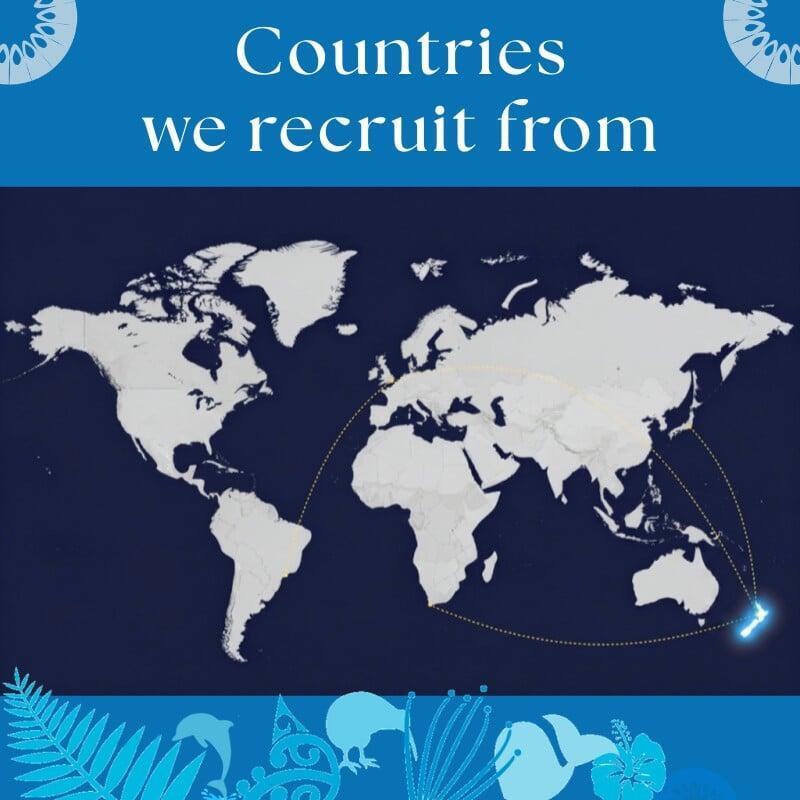
We prioritise enquiries from overseas psychologists who are eligible for New Zealand registration and whose skills and scope of practice match our clients' needs. Our website only lists countries where psychologists have successfully registered in New Zealand, or where available information suggests their qualifications likely meet local standards. If key requirements cannot be confirmed, we exclude those countries, as we cannot advise or assist with applications. Common barriers include:
Insufficient online information in English to verify the equivalence of qualifications, training, or regulatory systems.Lack of postgraduate qualification (post-master's) in clinical, forensic, educational, health, or neuropsychology to meet New Zealand's scope of practice criteria.Fewer than 1,500 hours of supervised practice as a trainee psychologist. Many programs offer only 1,200 or even 1,000 hours, which is not enough.
Supervised practice lacking adequate supervision, formal evaluation, or accreditation by an appropriate regulatory body.
Absence of a national registration or licensing framework for psychologists, or a regulatory body that does not specifically oversee psychologists or lacks key standards such as a code of conduct, core competencies, ongoing professional development, or enforcement.
If Your Country Isn't Listed
We understand your disappointment when your country is not listed on our registration form. However, this does not reflect your skills or experience as a psychologist. We simply lack information about your country’s qualifications, training, or regulatory system—a key requirement to proceed at this time.
Key Takeaways
The New Zealand Psychologists Board—not us—sets the criteria and evaluates overseas qualifications. Our feedback is based on our understanding of registration requirements, potential barriers to practice, and our recruitment experience. Only the Board can formally assess overseas qualifications. For comprehensive information on registering as an overseas-trained psychologist, visit their website
If your country’s qualifications or regulatory systems don’t yet align, know that many countries are improving their standards. As global requirements evolve, we hope to expand our countries list. Stay updated on changes in your country’s systems, as these may increase future opportunities.
The New Zealand Psychologists Board—not us—sets the criteria and evaluates overseas qualifications. Our feedback is based on our understanding of registration requirements, potential barriers to practice, and our recruitment experience. Only the Board can formally assess overseas qualifications. For comprehensive information on registering as an overseas-trained psychologist, visit their website
If your country’s qualifications or regulatory systems don’t yet align, know that many countries are improving their standards. As global requirements evolve, we hope to expand our countries list. Stay updated on changes in your country’s systems, as these may increase future opportunities.
We cannot regularly review all countries, especially non-English-speaking ones, for changes. If you know psychologists within our recruitment scope who have registered in New Zealand, please let us know so we can update our list.